

Looking backwards
When creativity starts from something instead of nothing, because of AI

Staring at a blank page is the starting point of most creative work. It is what may trigger the so-called writer’s block, and it happens across every kind of making: when you sit down to write a piece, when you sketch the interface of a piece of software, or, for the more artsy among us, when you go to paint.
Yet, nowadays, this is potentially no longer a thing, or no longer a problem, if you will.
The reason is that, with Generative AI, we can always start from something: the distance between a blank page and one, two, multiple pages of text or a scrappy interface or graphic has become very short. It is maybe just one prompt away.
Producing content - whatever shape that content takes and no matter the quality - has become a commodity.

And that changes the way we begin work, especially the creative one.
Yet this doesn’t come without consequences, and they are worth reflecting on.
This very fact of having an anchor can save us - or maybe drown us - in skipping some very initial questions, as the frame is already there. It may also create the fatigue of re-making something, with less awareness of how it got there. And the pull is to keep working on it rather than to start again.
But it’s not just that: as the Pope points out in his last encyclical ‘Magnifica Humanitas’ (Magnificent Humanity) on AI, ”the speed and ease with which answers or summaries can be obtained risk extinguishing the desire to ask questions, which is a process that bears fruit only over time.” Facing something that goes this fast may indeed create some fatigue, maybe make us lazy, and more importantly stop deeply questioning what we’re producing.
Even worse, when using AI, which Mozilla describes as a force for ‘Acceleration, Simulation, and Homogenization’, we may be tempted to treat is as a perfect machine, given how polished the outputs are (bear with me on the output item, we’ll get back to it soon)
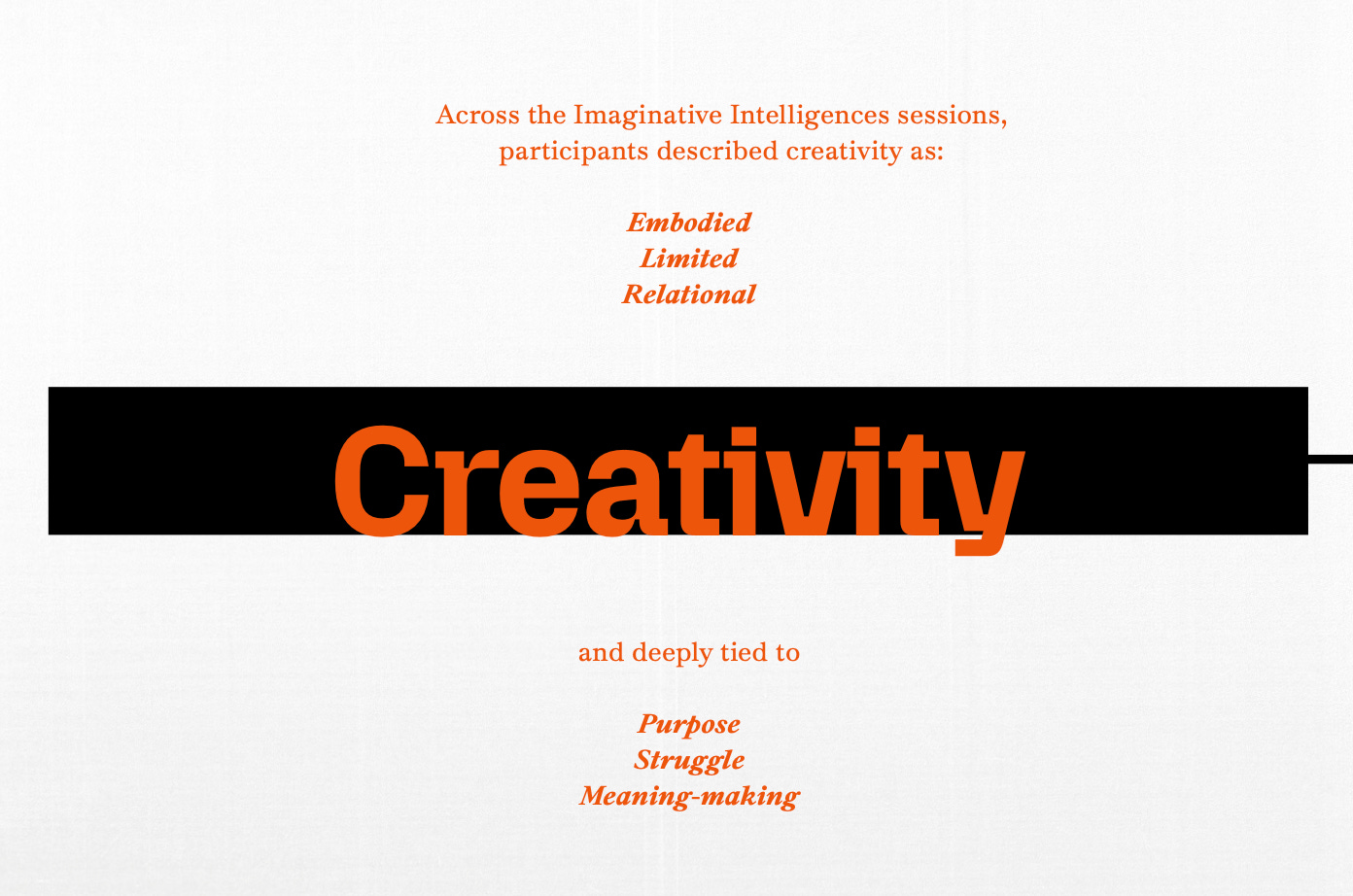
But this is a risk, and not because of philosophical speculation or any Luddism, but because of the technological foundations of AI. In other words, because of how AI is built - so let’s look into the machine.
AI is, primarily, a statistical machine. It is trained, as we know, to retrieve the data it was fed and to produce what is plausible on the basis of it. And here we go back to AI as a technology of average both in the quality of the writing and in the calibre of the ideas.
It is, in other words, a machine built to look backwards: it generates what is most probable given everything that came before, and not necessarily anything creative.
Now, you could fairly object that human creativity does the same: we’re inspired by what we read or listen to and use it for our creative work. True.
But the difference is probably in the purpose and direction. The machine works backwards, from probability. We work forwards, from intention - taking what we know and questioning it, merging it, putting it back together on purpose.
Maybe, that act of repackaging with a reason is what makes creativity worth something.
It is, in other words, not just to produce something new out of the knowledge we have, but to give it meaning in the new shape we confer. The output is only part of the story.
With AI, the rest of that story goes missing. We ignore the process that runs from input to output, because all we ask of the output is that it be good enough. The process itself stays inscrutable - technologically, what happens between A and B is not something we can control nor understand.
And indeed, we don’t care whether AI is actually intelligent - let alone creative! - only whether its output resembles something we humans would consider to be the work of an intelligence.
This is, after all, the founding premise of the field. In 1955, McCarthy, Minsky, Rochester, and Shannon opened ‘A Proposal for the Dartmouth Summer Research Project on Artificial Intelligence’ - the document that launched AI as a discipline - by defining the problem as ‘that of making a machine behave in ways that would be called intelligent if a human were so behaving’.
What mattered, from the start, was the appearance of the result, not the process
In that sense, AI is not far from a dishwasher: you don’t care about how the dishes got clean, only that you can eat off them again.
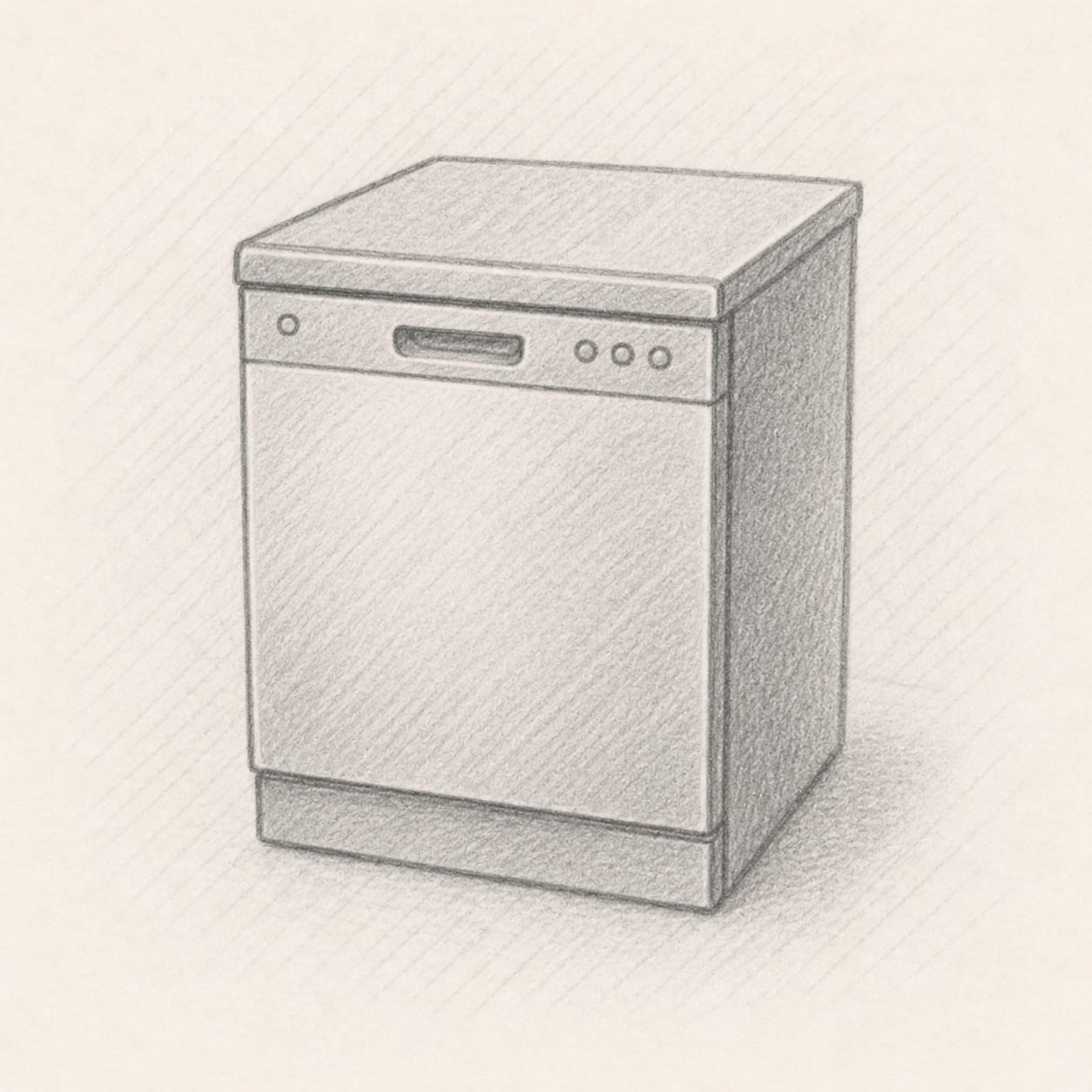
For most things, that’s a perfectly good arrangement - drafting an email, say. It becomes a problem with creativity, because there we risk missing what creativity actually is, and what it is for.
Stand in front of a painting and you care about more than the final artifact, important as it is. You care also about how it came to be.
For instance, last weekend I stood in front of Guernica. Stripped of its background - without knowing what Picasso wanted, without the history behind it - I thought the canvas loses much of its force. The image alone is not the point.
And importantly, the process matters not just to those receiving it or consuming creativity, but for the people making it - who begins at a blank page and, through a cognitive, creative struggle, arrives somewhere.
This newsletter was supported by Imagine Intel, the zine and cultural artifact published by Mozilla Foundation to accompany the Imaginative Intelligences Assemblies work led by the Foundation’s Creative Futures program. Check out the work of The Counterstructural Commons, Mozilla Foundation’s cultural R&D residency at Rhizome.

Save for Later
The encyclical I quote above? Someone ran the numbers and thinks Claude wrote much of it — em-dashes, “genuinely,” etc. A warning against mistaking the machine for a mind, maybe written by the machine ?
Fitting, then, that a book called The Future of Truth was full of AI-hallucinated quotes. Wikipedia now has a field guide for spotting the machine’s hand — check your own tics.
On the rules: Musk and Zuckerberg talked the White House out of AI oversight, while another order wants federal chatbots proven not “woke.”
Why the whiplash? Warzel: “Silicon Valley is trying to speedrun the singularity.” Benedict Evans’s new deck on AI eating the world is the calm version.
For builders: when agents are the users, what’s left to defend?
Maldita found TikTok working as an “open buffet” for predators. On the brighter side, Snapchat’s DSA ad transparency is worth a look.
A beautiful conversation on AI and prediction:
The Bookshelf
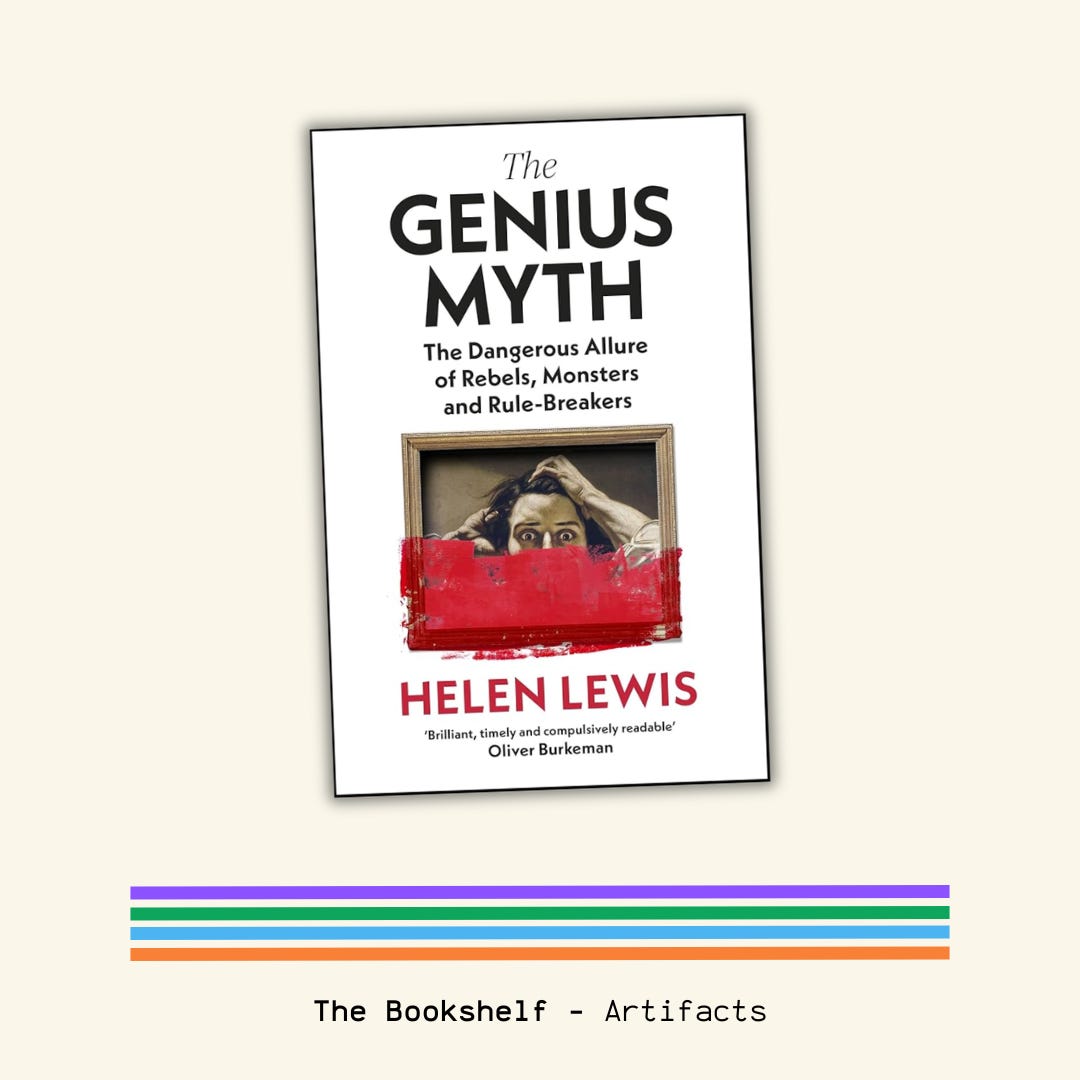
Creativity is often linked to being a genius. But what even is a genius? Maybe just the outcome of a narrative? This book dissects the topic across centuries, and it’s a nice read to trigger interesting conversations with people.
📚 All the books I’ve read and recommended in Artifacts are here.
Nerding
If all you care is just writing, writing, writing - and no AI assistance or anything, well IA writer is made exactly for it. And it produces splendid markdown, which is definitely the format of the moment.
☕?
If you want to know more about Artifacts, where it all started, or just want to connect...
Great piece. Quick personal experience related to what you wrote. Until not much ago, when I wanted to write something longer than a few paragraphs, I started brainstorming with AI, or letting AI write the first draft. I no longer do it and I think it's a trap. Maybe (probably) AI would have saved you 20 minutes coming up with the same ideas, and more, but those 20 minutes of thinking about the problem and trying to write a first outline are so so important and have cascade consequence on the form of the final writing.
Incidentally, I got someone on X claiming that he saw firsthand that the first draft of MH was actually written with pen and paper. My (uninformed) guess is that Claude was used on the translation and/or in the final refinement, rather than as the first draft.