

Ask EU how
A few of the ideas the Brussels bubble is currently debating on technology

Last week, Artifacts attended the Politico AI & Tech Week in Brussels.
Topics went well beyond AI - sovereignty, data, chips, platforms, online safety, entrepreneurship. Which is refreshing, since AI dominates so much of the conversation everywhere.
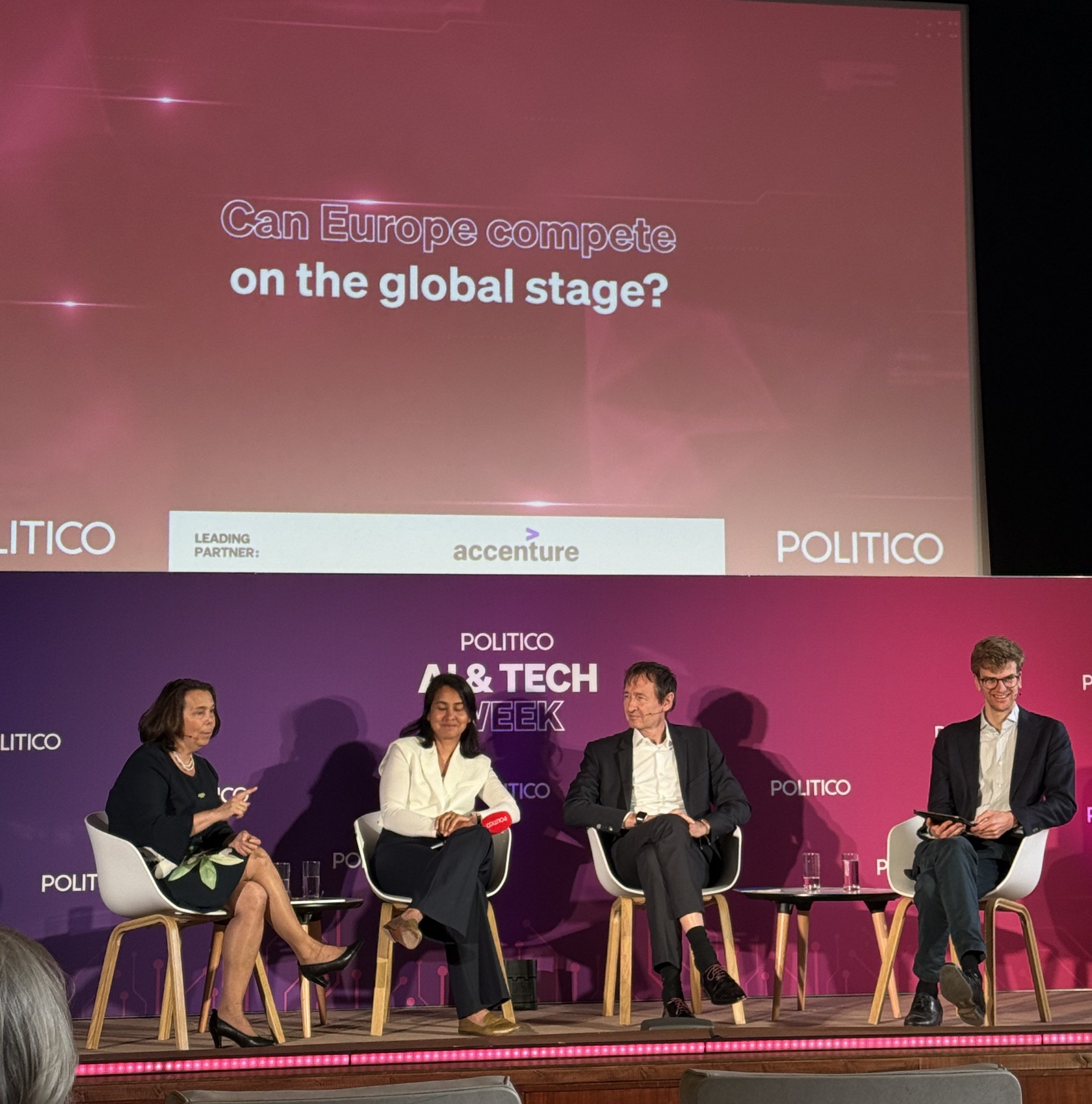
What struck me was the breadth of opinions, moving past the tired regulator-versus-private-sector dichotomy. Instead: regulators more open to explain and listen, third parties trying to mediate, scaling companies voicing their needs, large enterprises less defensive, academics naming the complexity.
But there’s still a pattern quite visible: a fundamental disconnection between those designing regulation and those building the technology, who rarely attend such events. Which then triggers lots of talks about the what needs to be done, and much less about the how to get there.
Finally, a special mention goes to the Politico journalists, who asked precise questions, pulled speakers back on track when needed, and kept pointing toward where the real complexity lives.
Anyway, here are five things the Brussels Tech ‘Bubble’ is discussing - in an attempt to make it readable for those outside of it (and go follow Unbubble Hub, speaking of bubbles)
First of all, Europe wants more control on the technologies we use
This is the thing everyone agrees on. Sovereignty is the political frame of such control, with the core idea being “someone on the other side of the planet cannot switch off our infrastructure.” Therefore, it’s also a matter of strategic security.
Less agreement exists on what counts as a European technology and when it can really be considered sovereign. More importantly, it remains unclear which domains to prioritize - semiconductors, cloud infrastructure, data centers, software - and what the real impact would be on the private sector actually building these systems. Yet, end of the month may provide more info with the release of the ‘Tech Sovereignty Package’ by the Commission.
Therefore, Building European is the path
The idea that Europe and European companies can build breakthrough technologies is no longer a myth.
Simplification packages like EU inc - a streamlined legal structure for digital startups - are welcomed with genuine enthusiasm and curiosity. Much more alignment exists on the idea that regulation need not be a drag but should enable easier business. And finally, pushing for a Eurostack - a European-controlled tech infrastructure - and actively financing innovation seems to be the way forward.
That’s why Antitrust matters (a lot) on AI
To avoid scenarios like Google Search edition 2, where the search market is heavily concentrated, with AI it’s critical to prevent companies from entrenching themselves as blockers. This matters especially for Europe’s hope to keep alive the dream of a European AI flagship company.
And still on AI, the real work with regulation is actually on implementation
It was fun to be in Brussels at the Politico event on the day of the AI Omnibus, which meant a delay and a simplification in the implementation of the AI Act. It’s also increasingly clear that AI regulation is primarily AI governance - not just the rules, but how they’re enforced. The actual work starts after the paperwork, and many speakers suggested Europe is behind here.
Figuring out how to operationalise the AI Act is what will keep the bubble busy in the months ahead. Getting this right matters for safety, for clarity, for whether the rules can actually be enforced. This whole situation brought me back to someone who once told me: “A politician who doesn’t care about the outcome of their policies is like a CEO who doesn’t care about the outcome of their product.” That’s probably something to keep in mind.
Which is a very similar story to the one on Age Verification
Age verification has become the new buzzword in tech regulation. Everyone agrees, of course, that protecting children online is a priority. Yet fewer people grapple with the complexity of actually implementing a proper verification system - the technical and privacy problems, the likelihood of bans, what we do with VPNs (with some ideas that seem quite bizarre, to say the least)
This is the clearest example of the what versus how gap. Easy to agree on the goal (protecting children), harder to think through implementation. On this matter, which is fundamentally technical, the debate remains heavily political.
It will take time and considerable controversy, while the EU Commission just announced they’re considering a social media ‘delay’ (=ban) for minors this summer, pointing to the recently released EU age-verification app.
On age verification, I had written a piece btw:
Shut that door

In these days, in Australia anyone under 16 will lose access to the usual parade of social platforms: Snap, YouTube, Facebook, Instagram, etc.
Save for Later
What if bots revive debate and democracy?
New CivicTech Guide to check out but also how governments use GitHub.
Someone claims HTML is back because of AI. Others that Gen Z doesn’t love AI that much. And finally maybe tokens are the currency of tomorrow?
The US Administration wants to look more into powerful AI models. In the meantime, Mythos by Anthropic helped Mozilla spot a lot of vulnerabilities.
On media, Substack is losing ground, but also how to get better at spotting deepfakes.
Why you should do one thing at a time.
The Bookshelf

Not a book on tech, but rather on Europe and its history. Research claims our brain is made for stories, and so reading those of ‘normal’ people that made Europe can be a good way to get to know more about how we got where we are. And Raquel Varela writes so well :)
📚 All the books I’ve read and recommended in Artifacts are here.
Nerding
Ok today we go full speed on Europe! In case you want to use less and less non-European tech, European Alternatives is the go-to portal to support your transition on all the different services.
☕?
If you want to know more about Artifacts, where it all started, or just want to connect...