

It is not normal
And why with AI we need to clarify, align and prioritise incentives

Artifacts is not meant to be a news newsletter, but what has happened between Anthropic and the US administration over the past few months is worth a recap. It comes in two separate episodes.
First episode, at the start of the year. The Pentagon wanted Anthropic to agree that its models could be used for “all lawful purposes.” Anthropic refused, asking for two exceptions: no fully autonomous weapons, and no mass domestic surveillance of Americans.
The administration did not take it well. It moved to label the company a “supply chain risk”, and by late February the President had ordered federal agencies to stop using Anthropic’s technology altogether. Anthropic sued.
Second episode, in early summer, and a different story. In June, Anthropic released Mythos, a model it described as too dangerous to hand over as-is, alongside Fable - the same model with built-in guardrails against malicious uses.
Within days, a jailbreak was found in Fable, and reports emerged that a China-linked group had accessed Mythos. The administration reacted with export controls barring foreign nationals from using the models - including Anthropic’s own non-American employees, which is odd given how many of them there are.
Thus, Anthropic disabled both models for everyone, worldwide. A few weeks later the controls were lifted, and the models are back - on the condition that Anthropic proactively detects security risks and reports malicious activity to the government.
That last condition matters. There is no formal law here yet, but a pattern is forming: the state now sets terms on when and how a model reaches the public. OpenAI, too, staggered its latest release “following pressure by the US government.”
There is a clear takeaway out of the past few months: AI is not a normal technology. Therefore, its use, deployment, and regulation cannot be normal.
I borrow the phrase from Arvind Narayanan and Sayash Kapoor, who argue the opposite in their much-cited essay “AI as Normal Technology.” Their point is about diffusion: AI will spread and embed itself across the economy gradually, the way electricity or the internet did, and so we can govern it with the ordinary tools we already have.

On that layer, they may well be right. But the past few months have played out on different levels: geopolitics and national strategy, none of this looks normal at all.
AI not being just a normal technology can be inferred when looking at the 2 main actors involved:
AI companies (OpenAI, Anthropic etc) who claim to be building the future of intelligence, while also warning that some of their models are too dangerous
US Administration being so involved in what’s going on, notably keeping a close eye on the models and spotting risks. But, more importantly, being aware that AI is critical technology also on the geopolitical realm and has, therefore, implications in the challenges with China too
Let’s look into this more:
For companies, a beautiful piece from Cal Newport has criticised their approach. If they claim their models to be dangerous, it could be for 2 reasons:
this is true and therefore worrying - but maybe the solution should rather be to really stop and think about what has been done? AI companies keep pushing cause they know other companies will do, so they can’t lose ground. But if you really think what you’re doing is too dangerous and you put it out there, well then maybe more responsibility is needed?
maybe it’s not that true, it’s just a marketing move - but is that responsible? Are we joking?
Let’s assume 1 is true. Last week, I had the chance to listen to Yann LeCun, former Chief AI Scientist at Meta and now founder of AMI Labs, who just said “if you claim it’s too dangerous, what about starting to do things differently?”
In other words, AI technologies are far from being deterministic - the people building them can put guardrails. So if you’re concerned, just stop?
If you’re aware of these risks and you’re in control of the design of such technology, you draw the consequences.
Differently, claims and warnings seem sometimes misaligned with the downstream actions.
If one is to trace why, it could go up to the incentives driving AI companies, which may not just be safety, as they keep raising money from private investors, target IPOs with debatable financial fundamentals, and are racing against each other while being all far from profitable.
But the administration side of things is not less interesting. Even a laissez-faire administration like the current US one seems to be concerned about AI safety, and for incentives reasons too. It started with cutting on any existing AI regulation framework, then things have changed with the current proposal being a vet on models.
What it is clear though, beyond regulation, is that the US administration needs (and thus has incentives) AI, for a couple of reasons: it’s a critical technology for war operations (and the world is not peaceful right now) but it’s also a matter of competitiveness on the global field, where the threat coming from China is not irrelevant.
And therefore the grip on AI is different from previous attempts at regulating technologies like online platforms or data privacy, and it pertains more to a strategic technology.
It may be not dissimilar from nuclear technology, for which special plans were put together (you watched Oppenheimer, no?). With, yet, the small detail that such strategic technology is not being developed within universities or public settings but by private organisations that, of course, are looking at being profitable.
So, reconciling the two positions of companies and the state, we are facing a more-than-normal technology, with alarms and warnings about safety being raised by those building and those regulating, but also all of this being pulled by other incentives.
I once read that incentives are superpowers. Here they seem to be many, and misaligned - within and across AI companies and the administration - while all acknowledging (or even raising!) the potential dangers or threats.

If these dangers or threats are real, lining up incentives is not enough: they have to be prioritised.
Here is a test for whether that is happening. When a company says a model is too dangerous, it is describing an obligation it now carries, and we should hold it to that. Too dangerous to release, released anyway, banned abroad, back by morning: these words should not cost nothing and cannot be just another way to launch a product.
We built institutions around strategic technologies. This one we have handed to companies with many different incentives, and left them to sort out the contradictions in public, with chaos for citizens being the first immediate outcome.
If we get better at this, the first result would be to stop seeing public communications being often contradictory, at the expense of users and citizens, and finally aligned with clearer incentives and principles about how AI is being built and distributed.
Save for Later
The thread that won’t leave me alone — AI and the state. The Atlantic on the quiet nationalisation of AI. Estonia, more concrete, is handing AI agents their own digital IDs - a passport for bots, liability baked in.
Two on the cracks: you can sweet-talk an LLM into misbehaving (flattery and authority push compliance from 35% to 51%), and vibe coding’s security bill is coming due - nearly half of AI-generated code ships a vuln.
Kids and screens, going global: the NYT maps the worldwide ban wave and the EU looks set to join in September. Ban first, sort out age verification later? Btw, Mozilla on connection bloat - the median Instagram user follows 675 accounts, and intimacy is built on subtraction.
Ah, and the Reuters Digital News Report 2026: social overtakes TV as the world’s front page. For the beach bag, All Tech Is Human’s summer reading list.
And GitHub will now ship your public repo on CD-ROM - “yours forever. Until you lose it.”
The Bookshelf

Currently reading “Prophecy” by Carrisa Veliz, which is not necessarily about the geopolitical challenge on AI but a great step back to understand the power of predictions and what AI is based on. Hugely recommended!
📚 All the books I’ve read and recommended in Artifacts are here.
Nerding
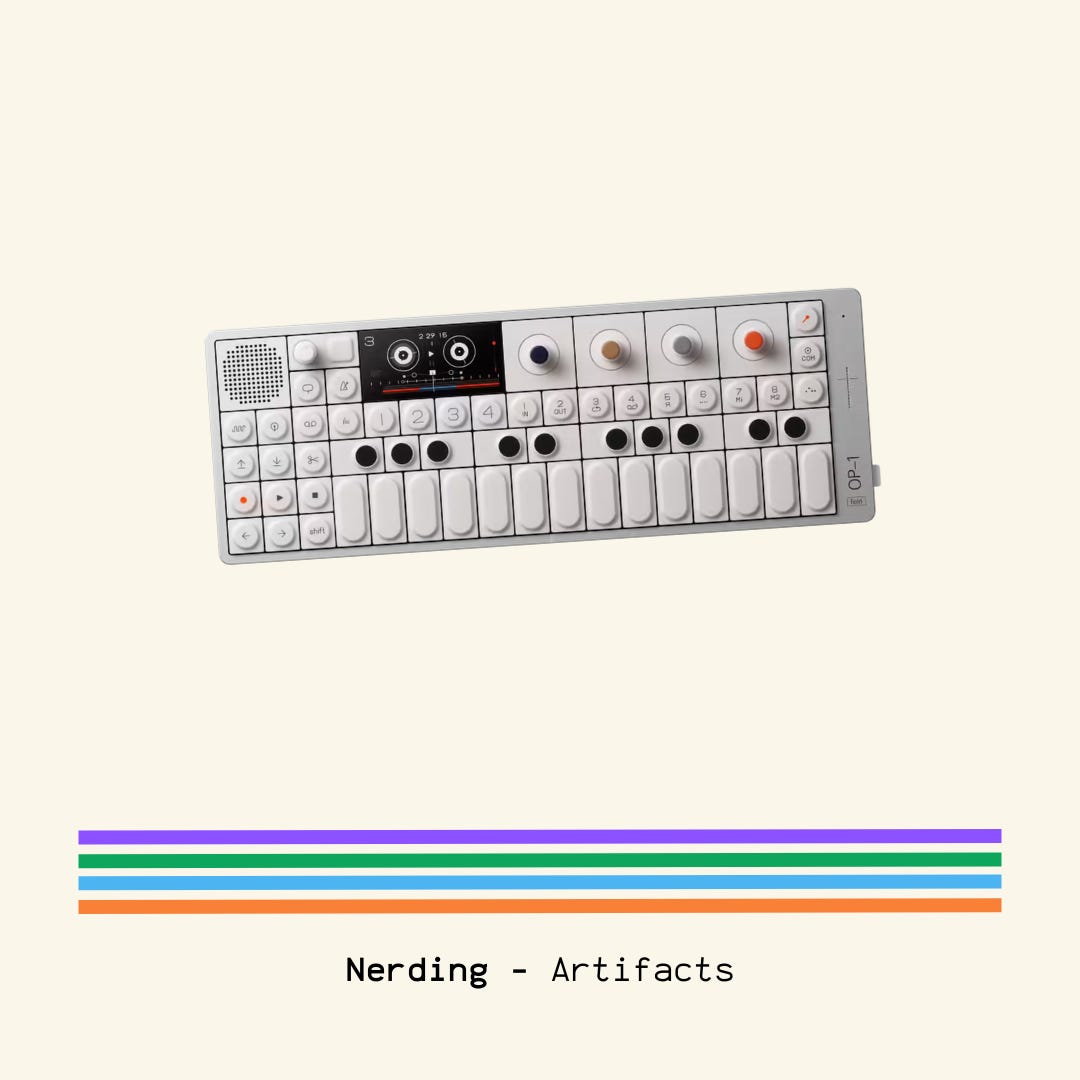
I usually recommend online tools (mostly free). This artefact from teenage engineering is of course physical and far from free, but I fell in love with it so go check it out, listen to the music it produces, enjoy!
☕?
If you want to know more about Artifacts, where it all started, or just want to connect...